Peace Studies Workshop – 2
Event Coordinator: Assoc. Prof. Dr. Başar Baysal
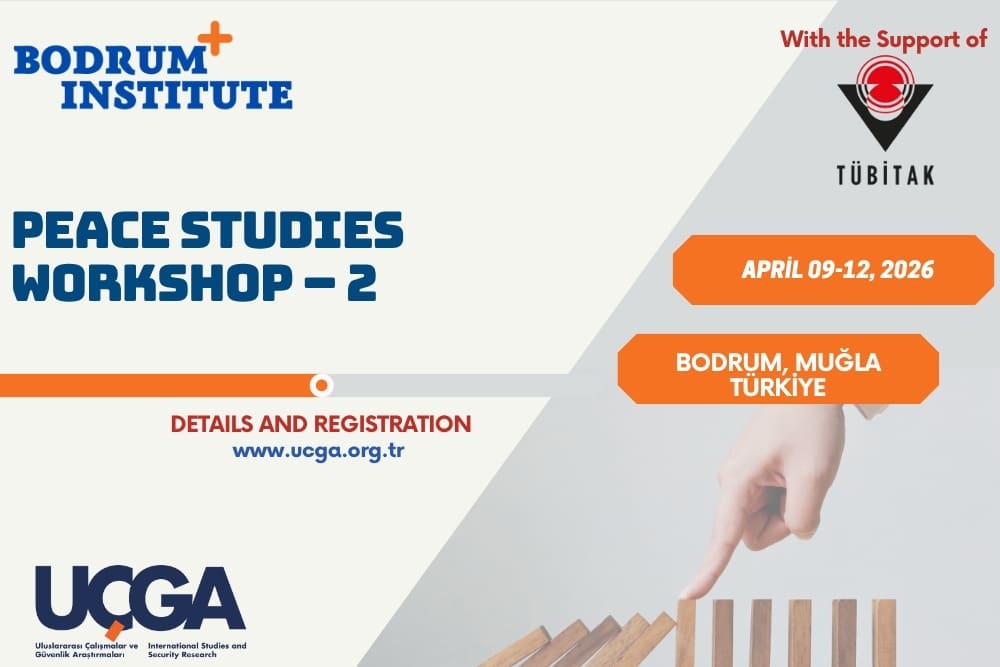
Bodrum / Türkiye (April 09-12, 2026)
Peace Studies Workshop – 2 Took Place in Bodrum
Organized by the Bodrum Institute with the support of TÜBİTAK, the Peace Studies Workshop-II was held in Bodrum between April 9–12. Within the scope of the program, peace and security studies were addressed from an interdisciplinary perspective.
Theoretical Framework and Academic Sessions
In the first phase of the workshop, the following theoretical lectures were delivered by academics:
Assoc. Prof. Dr. Başar Baysal: Opening Session and “Process and Actor Analysis in Peace Studies, DDR Processes, and Conflict Economies”
Dr. Burak Toygar Halistoprak: “The Conceptual Framework of Peace”
Dr. Esra Dilek: “Transitional Justice”
Dr. Büşra Alparslan Özçeker: “The Role of Morality and Emotions in Intergroup Conflict”
Prof. Dr. Esra Çuhadar: “Inclusive Peace Process Design”
Assoc. Prof. Dr. Cihan Dizdaroğlu: “Youth and Peacebuilding”
Participant Presentations
In the second part of the program, participants presented their research topics. The papers presented within the scope of the workshop are as follows:
Oğuzhan Bal: “Beyond Energy Geopolitics in the Eastern Mediterranean: Ecological Peacebuilding and the Role of Environmental Cooperation in Conflict Transformation”
Dr. Bünyamin Esen: “Venezuela 2026: The Abduction of Maduro and the Unraveling of the Liberal International Order”
Dr. Mehmet Ali Ak: “Analyzing Rational Intractabilities through Ontological Security Theory: The Aegean Crisis and Serbia-EU Integration Process”
Dr. Melek Aylin Özoflu: “Populist Foreign Policy Making During Conflicts: The Cases of Hungary and Türkiye”
Dr. Rumeysa Hatice Uludoğan: “A Comparative Analysis of the Council of Europe’s Peace Education and Intercultural Education Policies: The Case of Bosnia and Herzegovina – Serbia”
Öykü Erdem: “Sports Events from Soft Power to Peacebuilding”
Merve Özten Yıldız: “India’s Indo-Pacific Narrative and Regional Order Building (2017-2025)”
Yasemin Kaymaz: “Israel’s Security Policies from the Perspective of Chosen Trauma”
Damla Altınay: “Conflict and Peace on Digital Platforms: A Comparative Analysis of Boko Haram Propaganda and PeaceTech Counter-Narratives in Nigeria (2015-2024)”
Musa Akgül: “The Crans-Montana Process: Anatomy of a Failure”
Elif Ezgi Keleş: “Ontological (In)securities in the Russia-Ukraine War: Motivations of Foreign Fighters”
Gülistan Alpaslan: “Can Environmental Cooperation Build Lasting Peace?: On Ecological Peacebuilding in Sub-Saharan Africa”
Sude Toptaş: “Nation-State Imagination in Lebanon”
Following the presentations, academics provided comprehensive feedback on the participants’ papers. At this stage, where each study is aimed to be transformed into an academic publication or project in the future, the participants’ questions and the academics’ evaluations enriched the discussions. The workshop offered a productive academic platform where theoretical knowledge was blended with current case analyses.
You can access the call for applications and details regarding the Peace Studies Workshop 2 below:
The “Peace Studies Workshop” aims to enable doctoral students studying in Türkiye and abroad, primarily in Political Science and International Relations and similar fields, or early-career researchers who have completed their PhDs working on peace and conflict processes, to develop their research and training capacities at theoretical and practical levels in the field of peace and conflict resolution within an interactive platform. It also aims to bring them together with instructors and colleagues working on similar topics to establish an academic network. In this way, creating an epistemic community in the field of peace studies in Türkiye represents the long-term goal of the event. Within the framework of the facilities offered by the venue where the activity is planned to be held, all participants and instructors will have the opportunity to be together full-time in addition to the classes during the 3-day event. Thus, it will be possible for the academic discussions in the classroom environment to continue during meals, class breaks, and subsequent independent times. This interaction between participants and instructors will also facilitate the shaping of future joint academic studies/projects.
Within the framework of this activity designed in a workshop format, participants will be provided with training in the core areas covered in the program section via the buttons below. Furthermore, participants will have the opportunity to present their current work and receive feedback from competent experts in the field. As a result of the Peace Studies Workshop event, it is aimed to strengthen the research and educational capacities of early-career researchers in peace and conflict processes in the following fundamental aspects:
- Establishing an academic network among doctoral candidates or early-career researchers and expert instructors currently working and producing academic publications in the field of Peace Studies; thereby increasing interaction and knowledge sharing.
- Evaluating the current literature in Türkiye and the world in the core areas of the activity, identifying the gaps in these areas, and enabling joint studies and projects with early-career researchers in these fields.
- Enabling researchers to develop their current studies by receiving feedback from colleagues and expert academics in the field on the papers they have prepared in their areas of focus, thus paving the way for these studies to be published in high-impact journals.
- Ensuring that especially doctoral student participants can receive feedback from various academics who are experts in their fields regarding their thesis work.
- Enabling early-career academics to gain the ability to develop arguments and analyze current issues in their fields of study, and to engage in in-depth discussions accompanied by expert instructors.
Who Can Apply:
Participants of the Educational Activity will be selected based on the following criteria:
- Applicants are expected to be conducting studies in Political Science and International Relations, as well as related fields such as social psychology, sociology, anthropology, economics, and history. Students continuing their doctoral education in topics related to these fields and early-career academics who received their PhDs from these fields a maximum of 10 years ago are eligible to participate. Participants holding a PhD must be working at a university, educational and research institute, or an R&D organization.
- The training targets a comprehensive academic experience around the Peace Studies sub-discipline within the field of International Relations. However, Peace studies can also be studied from different perspectives by various disciplines. For this reason, participants will be selected from fields such as social psychology, sociology, anthropology, economics, and history, in addition to Political Science and International Relations.
- Diversity and inclusivity will be prioritized in the selection of participants. Accordingly:
- Participation from different cities and universities will be encouraged;
- Equal representation will be ensured by considering gender balance;
- Active participation of attendees from universities in Anatolia will be supported, and priority will be given to these participants.
- Participants are required to be registered in the TÜBİTAK ARBİS database and have an up-to-date CV on ARBİS.
- Priority will be given to those who did not participate in Peace Studies Workshop-1.
- For the participant’s application to be evaluated, they must apply with a CV and a 400-600 word abstract of the study they will present, including the title, summary (objectives, literature, methodology, outcomes, innovation, contribution to the researcher, etc.), and keywords.
- Participants are expected to attend all classes during the training process, except for force majeure, and fulfill the tasks requested by the instructors.
- 15 participants will be accepted to the Peace Studies Workshop.
- Event applications will be received through the Bodrum Institute website.
Training and Accommodation Expenses
Training, accommodation, and subsistence expenses will be covered by the TÜBİTAK 2237 project budget, and no fee will be charged to the participants. In addition, participants will be provided with a travel allowance of 1500 TL (tax deductions apply).
DEADLINE AND RESULTS:
Applications will be accepted until Wednesday, March 18, 2026, at 17:30.
Evaluation results will be notified via email on Friday, March 20, 2026, only to the candidates who are entitled to participate in the activity.
To apply, please click the “Apply Now” button at the bottom of the page.
Organizing Committee
| Full Name | Title | Institution |
| Esra Dilek | Assoc. Prof. Dr. | Özyeğin University |
| Haldun Yalçınkaya | Prof. Dr. | TOBB ETÜ |
| Başar Baysal | Assoc. Prof. Dr. | Ankara Social Sciences University |
| Cihan Dizdaroğlu | Assoc. Prof. Dr. | Başkent University |
| Bezen Balamir-Coşkun | Assoc. Prof. Dr. | Necmettin Erbakan University |
| Burak Toygar Halistoprak | Asst. Prof. Dr. | Antalya Bilim University |
Local Organizin Committee
| Full Name | Title | Institution |
| Haldun Yalçınkaya | Prof. Dr. | TOBB ETÜ |
| Haluk Karadağ | Assoc. Prof. Dr. | Başkent University |
| Başar Baysal | Assoc. Prof. Dr. | Ankara Social Sciences University |
| Bedii Çelik | Project Coordinator | Ostim Technical University |
Scientific Committee
| Full Name | Title | Institution |
| Esra Dilek | Assoc. Prof. Dr. | Özyeğin University |
| Haldun Yalçınkaya | Prof. Dr. | TOBB ETÜ |
| Başar Baysal | Assoc. Prof. Dr. | Ankara Social Sciences University |
| Cihan Dizdaroğlu | Assoc. Prof. Dr. | Başkent University |
| Bezen Balamir-Coşkun | Assoc. Prof. Dr. | Necmettin Erbakan University |
| Burak Toygar Halistoprak | Asst. Prof. Dr. | Antalya Bilim University |